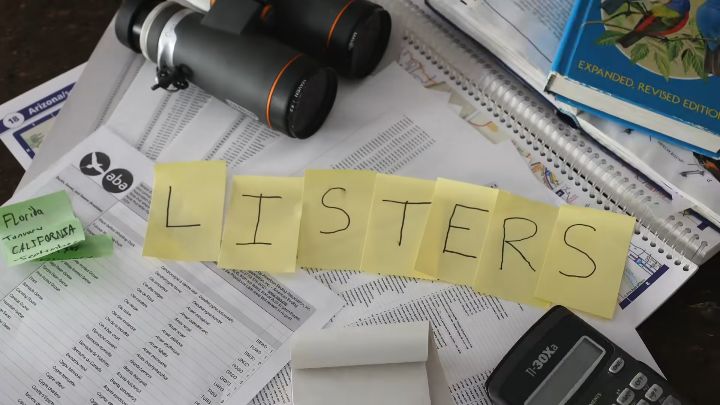
Several months ago, a good friend of mine, who knows I’m into birdwatching, suggested I watch a YouTube documentary called LISTERS: A Glimpse Into Extreme Birdwatching. Little did I know at the time that it would consume much of my free time and prevent me from blogging with my usual cadence!
I’ll say it right away: the documentary is one of the best I’ve seen. I was blown away by the storytelling, the camera work, the silly jokes and the overall quality of the movie that two guys from St. Louis were able to put together. And once they were done, they just posted it on YouTube. No fanfare, no proper distribution, no deals. In fact, I was so smitten by how good it was that I decided I needed to watch it with someone special in my life.
Here, however, is where the story gets more complicated. The person has functional knowledge of English, but there is no way she would be able to understand everything, even if she had English subtitles at her disposal. More importantly, she just would not be able to appreciate the many sarcastic and snarky comments, puns and stupid jokes that the Reiser brothers pull off so effortlessly. And I, being a person whose job touches on the translation capabilities of large language models, among other things, had a plan to overcome this.
The plan was simple: I had observed and measured first-hand the progress of LLMs in their translation capabilities. Now don’t get me wrong: I know both the good and the bad sides of LLM translations, and they are still far from perfect. But having access to some of the best models, surely I could do some smart prompting and have Claude or Gemini produce a mostly good version of the Czech subtitles; a rough diamond that I could polish to a shine. I had done some subtitling before, a long time ago when I worked as a linguist. I knew that it could be very time-consuming, but using an LLM seemed like a great trick to speedrun the effort. Oh, what a sweet summer child I was!
My expert subtitler and transcriber, Claude
I embarked on the journey, full of optimism and joy, hopeful that I’d stumble into one of the less discussed LLM capabilities that just work. And I have to say, my initial impressions were great! I told Claude to go through all the auto-generated subtitles from YouTube, identify all bird names, perform online research in reputable sources and give me a list of official Czech translations. I, knowing how easily and confidently LLMs will lie to you, even told Claude that whenever there does not seem to be a canonical translation, it should flag the bird name. Claude thought for many minutes, performed many online searches, which only boosted my hopes of a good outcome, and eventually returned a nice dictionary of bird names. Amazing!
Skimming the list and checking one or two, I did not find anything suspicious: The Czech names seemed like a good match for the English names, which made me a little less cautious than I probably should have been. The list looked good, so I went on to the next phase: crafting enough context for the LLM to be able to translate the subtitles in the style that I wanted. You see, the documentary is not your ordinary, serious nature documentary. No, LISTERS is very self-aware, self-deprecating, even irreverent at times, while finding the right balance to get you excited about and interested in it, even if the truth about it is sometimes messy, ugly and complicated. Oh, and there’s a lot of swearing too. This meant that the subtitles should try to match the vibe and intent of the speakers: swearing, informal speech and all.
After crafting the prompt that explained the style requirements and the intent, I set Claude loose on the whole subtitle file to translate it. It stumbled several times, running into tool-calling limits and other issues, but eventually it produced a file of Czech subtitles that, at least when spot-checked, seemed to mostly make sense. It even translated the swear words without holding back. Hallelujah! Maybe this would be even easier than expected, I thought to myself naively.
Bringing Gemini to help
I was quite happy with the first draft, but there was one thing that irked me. Many of the YouTube-generated captions were extremely short, and perhaps more annoyingly, the places they were split into individual captions rarely made sense. Merging, splitting and timing all of them would be a lot of work, but maybe that’s something that an LLM could help with too, right? I tried with my trusty old friend Claude, but it did not seem to understand my intentions very well, so I turned to its cousin Gemini.
After several iterations of adjusting the caption length, I started doubting my approach. Even when explaining in terms that the LLMs would understand (setting the boundaries of captions to boundaries of subclauses, etc.), the subtitles Gemini produced were quite underwhelming. It did not pick the best place to stitch subtitles in many cases, and once I started watching longer passages of the documentary with the stitched subtitles, I began to notice something. Not only did it stitch the subtitles in wrong places, but it often failed to combine their time markers in a way that would make sense. As a result, many of the subtitles were much shorter or longer than they should be, or just started at very odd times. At this point, I could feel panic seeping into my mind, but I did my best to convince myself that surely two LLMs and a human would be able to figure it out.
Fast forward a few minutes and a couple of corrective actions, and doubts fully settled in. But I had a plan: use faster-whisper to do the transcription instead of the auto-generated YouTube subtitles. And the subtitles did look better timing-wise, so I had them translated again, this time by both Claude and Gemini in parallel: I would use Claude’s version but peek at Gemini’s if it was underwhelming.
Getting punched in the face by reality
Now that the timing was mostly alright, I could go and start polishing the subtitles. I went through the first few minutes and had to make more edits than I expected (more like heavy editing than polishing), but we were still chugging along. The moment the first few birds were mentioned, however, I had an unsettling realization: despite Claude’s research, most of the bird names were trash. They were often made up, or simply plausible-looking (yet wrong) translations of the English names. At one point, it translated a black-capped vireo as a condor, confusing two birds no one would ever confuse. And since there was no easy way of telling which bird’s name would be wrong, I ended up checking and looking up authoritative translations for every single bird. Thanks, Claude!
Another realization set in not too long afterwards: the translation was far from good. It was mostly functional, in spite of many hilarious misses, but it did not meet the bar of being enjoyable and in line with the style and tone of the documentary. Some of the context was purely visual and absent from the text, so I couldn’t blame an LLM for missing it. And it’s not like I gave it an easy job either: assuming “flammies” meant flamingoes in a bird documentary was a fair mistake — except they weren’t talking about flamingoes at all. They meant flammulated owls. Last but not least, swear words didn’t hit right, sarcasm and irony were ignored, and jokes almost never landed. My future co-watcher deserved better than this.
And so began my toil. I started over with the Claude translation, but since I had committed to making this a great experience, I did it the proper way. I split or merged perhaps the majority of the captions. I retranslated almost every single caption. At some point, the documentary showed a man reciting a naughty poem about birds, so I went ahead and came up with a free translation that rhymed. I spent hours and hours working on the project. There were times when I wanted to give up: having sunk several days and still seeing the timestamp sitting at around twenty minutes out of a 2-hour documentary was not exactly motivating.
For comparison, an average blockbuster movie like 2025’s Superman, which is over 2 hours, has only about half as many words as the LISTERS subtitles. I did not count the hours spent subtitling LISTERS, but I am pretty sure it was 50+ hours. It was a lot, and maybe part of the reason was that I hadn’t really created subtitles in over a decade. I don’t really regret it either: I think this crazy and funny and beautiful documentary deserves subtitles in as many languages as possible. But most importantly, the person I did this all for liked it, and that easily repays all the hard work that I’ve put in.
Translation is far from a solved problem
The translation industry has been hit hard in the last few years, first with the advent of neural machine translation, and especially with the widespread adoption of LLM translations. It would be foolish to pretend LLMs aren’t taking over a growing share of work that used to go to humans. But my experience using them for subtitling gives me a fresh perspective. I’m sure there are optimizations I could have done to the process to make things go smoother, but I am equally sure that LLMs of today are simply not capable of producing high-quality translations of subtitles for a documentary such as LISTERS. We’re not there yet. And I believe we won’t be for some time to come.
Birds need your help too
I have a deep love and respect for all animals, and birds have really grown on me in the past few years. If you’ve read this far, I have two things I would like to ask you to do: first, if you haven’t watched the documentary, go watch it!
Second, birds are absolutely critical for ecosystems around the world, but an average person might not even know it. Whether it’s because of pest control, seed dispersal, pollination or ecosystem engineering, birds carry a lot of weight on their tiny hollow bones. And as one of the documentary’s later sections explains, bird habitat loss has real impacts on bird populations, creating ripple effects in the ecosystems. So if you’re willing to help birds, consider donating to one of the many bird conservation organizations around the world. The Reiser brothers suggest American Bird Conservancy and Friends Of Sax-Zim Bog. But finding an organization that is local to your country or area is just one Google search away: I support the Czech Ornithological Society and I’m sure you can find one that is close to you too. The little feathered miracles will appreciate your help!
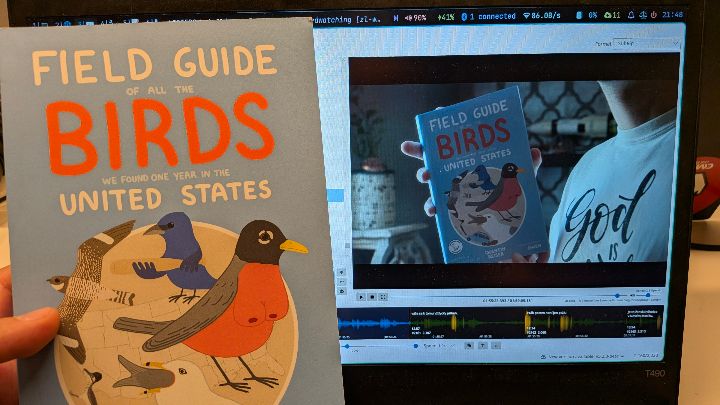
Last but not least, this beautiful documentary is available for free on YouTube, but you can support the Reiser brothers by buying the book they wrote about it called Field Guide of All the Birds We Found One Year in the United States. If you liked the documentary, you will like the book too. It’s a hoot!🦉
For those few of you Czech-speaking readers, the subtitles can be found here.